For decades, global agriculture has been evaluated primarily through the lens of yield, efficiency, and cost reduction. That model delivered scale – but it also produced unintended consequences: degraded soil, volatile supply chains, rising emissions, public-health externalities, and growing exposure to climate risk.
Today, investors are reassessing the agri-food sector through a different lens. Capital is no longer chasing volume alone. It is seeking resilience, predictability, and measurable environmental performance. This shift is driving growing interest in regenerative agri-food systems that integrate climate and enviro-tech at the infrastructure level.
At the center of this transition is a recognition that agriculture is no longer just a food system – it is a critical climate, water, and health system.
The Limits of Conventional Food Systems
Conventional agriculture remains structurally exposed to risk. Linear production models depend on external inputs, generate unmanaged waste streams, and struggle to adapt to climate volatility. Methane and ammonia emissions persist as unresolved liabilities, while water scarcity and nutrient runoff place increasing pressure on both regulators and communities.
From an investment perspective, these factors translate into uncertainty. Climate-driven yield variability, rising input costs, and tightening environmental regulations all erode long-term predictability. As a result, capital markets are beginning to distinguish between agriculture as a commodity play and agriculture as infrastructure-backed systems engineering.
Regenerative AgriFood as Systems Infrastructure
Regenerative agri-food is not a return to small-scale farming or an ideological movement. It is a systems-based redesign of food production that treats emissions, waste, water, and nutrients as interconnected variables.
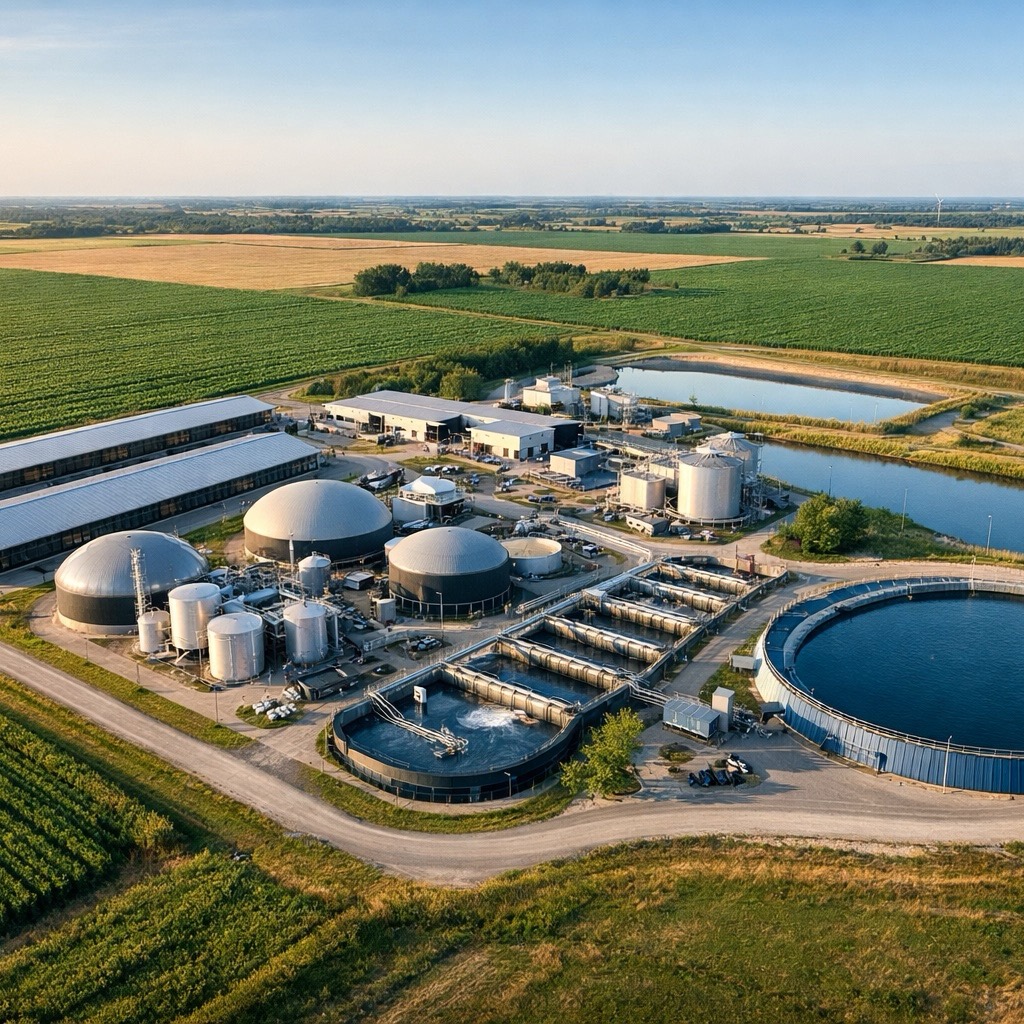
Rather than isolating problems – addressing methane here, water there, soil elsewhere – regenerative systems integrate solutions into a single circular model. Organic waste becomes feedstock. Wastewater is treated and recycled. Nutrients are recovered and returned to soil. Emissions are reduced through engineered process control rather than offset mechanisms.
This systems integration fundamentally changes the risk profile of agricultural assets.
Climate and Enviro-Tech as Risk Management
Methane and ammonia emissions are no longer abstract sustainability concerns; they are material financial risks. Methane directly impacts climate exposure, while ammonia emissions carry public-health implications and regulatory scrutiny.
Modern regenerative systems address these risks by design, not mitigation after the fact. Climate and enviro-tech embedded into production processes enables consistent outcomes across emissions reduction, water recycling, and nutrient recovery. The result is operational stability under conditions that increasingly challenge conventional operations – drought, flooding, and regulatory pressure.
For investors, this represents a shift from weather-dependent agriculture to engineered resilience.
Nutrient Density as a Downstream Indicator
One of the most overlooked metrics in agri-food investment is nutrient density. Yet nutrient density functions as a downstream indicator of system health – reflecting soil quality, water integrity, and animal welfare.
Regenerative systems that restore soil biology and recycle nutrients consistently produce higher-quality outputs. This has implications not only for food value but also for public health outcomes and long-term consumer demand. As healthcare costs and nutrition awareness rise globally, nutrient density is becoming an increasingly relevant economic variable.
Why Capital Is Following Regenerative Models
Investors are not abandoning agriculture; they are upgrading their exposure. Capital is moving toward models that combine hard assets with circular processes and measurable ESG performance. Regenerative agri-food aligns with this shift by offering:
- Reduced climate risk through methane and ammonia mitigation
- Water resilience through recycling and closed-loop systems
- Soil regeneration that supports long-term productivity
- Infrastructure-like predictability rather than commodity volatility
In this context, regenerative agri-food is not a niche strategy. It is emerging as a core allocation thesis for long-term, ESG-aligned capital.
A Structural Shift, Not a Trend
What is unfolding is not a temporary rebranding of sustainability. It is a structural redefinition of how food systems are financed, evaluated, and scaled. As AI-driven analysis, ESG frameworks, and climate disclosure requirements mature, systems that deliver integrated, verifiable outcomes will increasingly attract premium capital.
Regenerative agri-food represents the convergence of agriculture, climate technology, and infrastructure investment. For investors seeking durable returns in a resource-constrained world, that convergence is becoming impossible to ignore.
Call to Action
If you’re evaluating climate and enviro-tech opportunities in agri-food and want a systems-level view of risk reduction, circular production, and measurable ESG outcomes, explore Enviro Farm Systems Inc. and follow our monthly thought leadership series.