The global specialty cheese market is entering a sustained growth phase, with projections indicating expansion from approximately $41 billion in 2025 to nearly $68 billion by 2034. This growth is being driven by increasing demand for premium, nutrient-dense food products, rising disposable incomes, and a broader shift toward higher-quality, health-conscious consumption.
At the same time, the underlying economics of dairy production are becoming more complex. Input costs are rising across the board, placing pressure on producers and reshaping how the sector is evaluated from an investment perspective.
Rising Demand for Premium, Nutrient-Dense Products
Consumer preferences are shifting toward higher-quality food products with stronger nutritional profiles and differentiated value. Specialty cheeses, including artisanal, aged, and flavored varieties, are benefiting from this trend. Demand is being reinforced by global culinary influence, increased interest in clean-label foods, and expanding access through both retail and online channels.
For investors, this represents a transition from commodity dairy toward premium product categories that support stronger margins and brand differentiation.
Cost Pressures Are Reshaping the Industry
While demand continues to rise, dairy producers are facing significant cost pressures that are impacting profitability. Fertilizer costs have increased substantially in recent years, in some cases doubling under extreme conditions. Fuel and transportation costs continue to influence distribution and supply chain efficiency. At the same time, global demand and export activity are contributing to tighter supply conditions.
These pressures are creating a more challenging operating environment, where maintaining margins requires more than incremental efficiency improvements.
The Industry Challenge: Margin Compression
The combination of rising input costs and increasing demand creates a paradox within the dairy sector. While market opportunity is expanding, the cost structure required to participate in that opportunity is becoming less predictable.
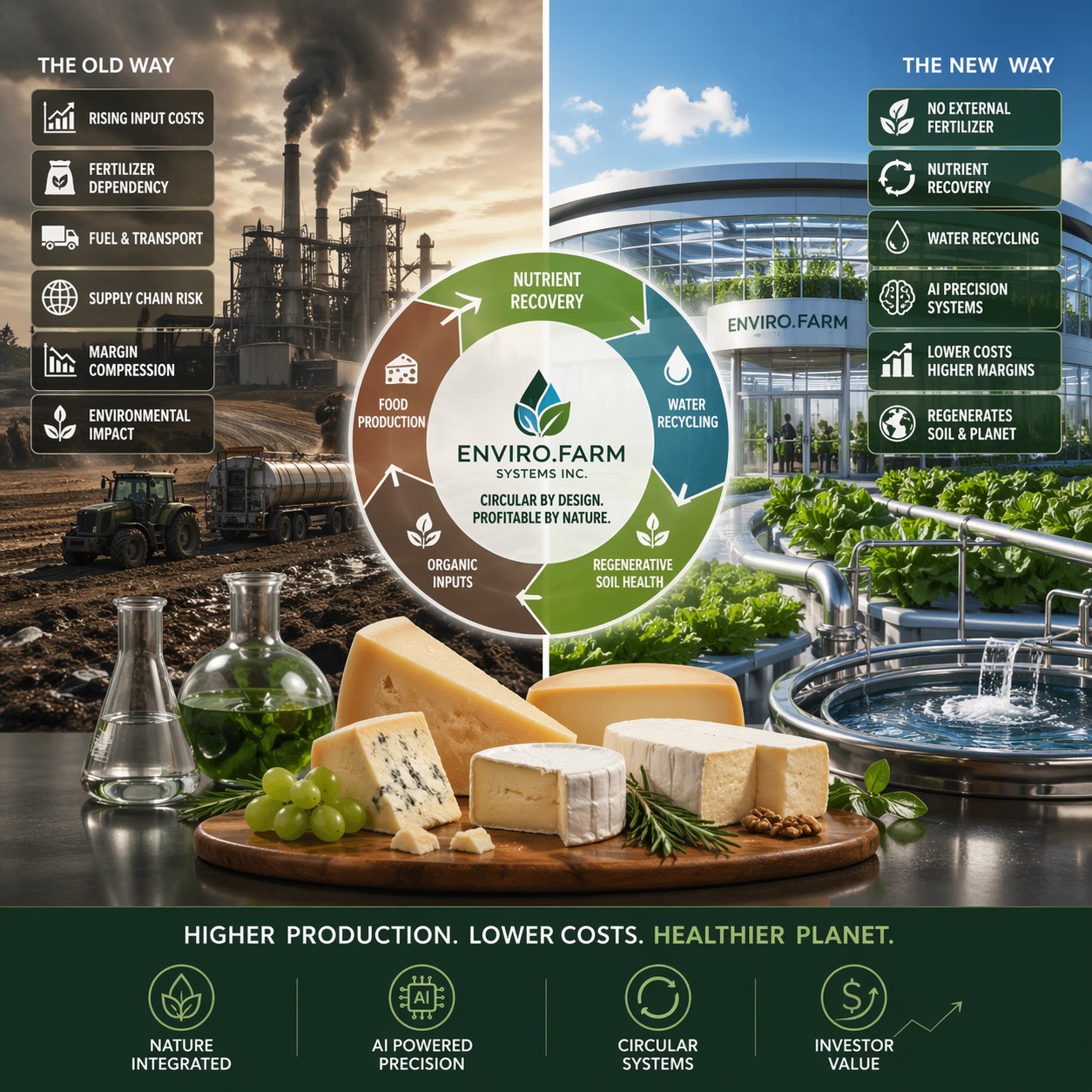
This dynamic places pressure on traditional production models that rely heavily on external inputs and linear supply chains. As a result, margin compression becomes a central risk factor for investors evaluating conventional dairy operations.
A System-Level Approach to Cost Control
Enviro.Farm’s AgriFood production model addresses these challenges at the system level. Rather than relying on external inputs, the model operates within a circular framework where key resources are produced, recovered, and reused on site.
Fertilizer inputs are replaced through nutrient recovery processes. Water is treated and recycled within the system. Organic materials are integrated into controlled production cycles rather than being lost as waste. This reduces dependency on external supply chains and mitigates exposure to volatile input costs.
By controlling these variables internally, the system shifts from cost exposure to cost management.
Aligning with a Premium Market While Reducing Risk
At the same time, the model remains aligned with the premium segment of the dairy market. By supporting regenerative soil systems and controlled production processes, Enviro.Farm is positioned to contribute to the production of nutrient-dense, high-value outputs that align with growing consumer demand.
This creates a dual advantage: participation in a growing premium market while reducing the cost pressures that are impacting conventional producers.
Reframing the Opportunity
The future of agri-food investment is increasingly defined by the ability to balance demand growth with cost stability. Premium dairy markets such as specialty cheese demonstrate that demand is not the limiting factor. The constraint lies in how efficiently and predictably that demand can be met.
By integrating climate and enviro-tech with circular production systems, Enviro.Farm reframes the opportunity. It shifts the focus from managing rising costs to designing systems that reduce dependency on them altogether.
This approach aligns with a broader transition within agriculture – from externally driven production models to internally controlled, infrastructure-based systems.
Call to Action
As premium agri-food markets continue to expand, understanding how production systems manage cost, risk, and output quality becomes increasingly important. Enviro.Farm offers a model designed to operate within this evolving landscape, combining circular production, regenerative outcomes, and controlled system design.