Environmental, Social, and Governance (ESG) considerations have become a significant factor in how institutional and private capital evaluate investment opportunities. While ESG reporting requirements continue to evolve globally, the underlying objective remains consistent: identifying businesses capable of generating long-term financial performance while producing measurable benefits for people, communities, and the environment.
For many investors, agriculture has traditionally presented a challenge within ESG frameworks. Food production is essential to society, yet conventional agricultural systems are often associated with soil degradation, water consumption, greenhouse gas emissions, nutrient runoff, and increasing dependence on external inputs.
As a result, investors are increasingly searching for agricultural models capable of improving both economic performance and environmental outcomes simultaneously.
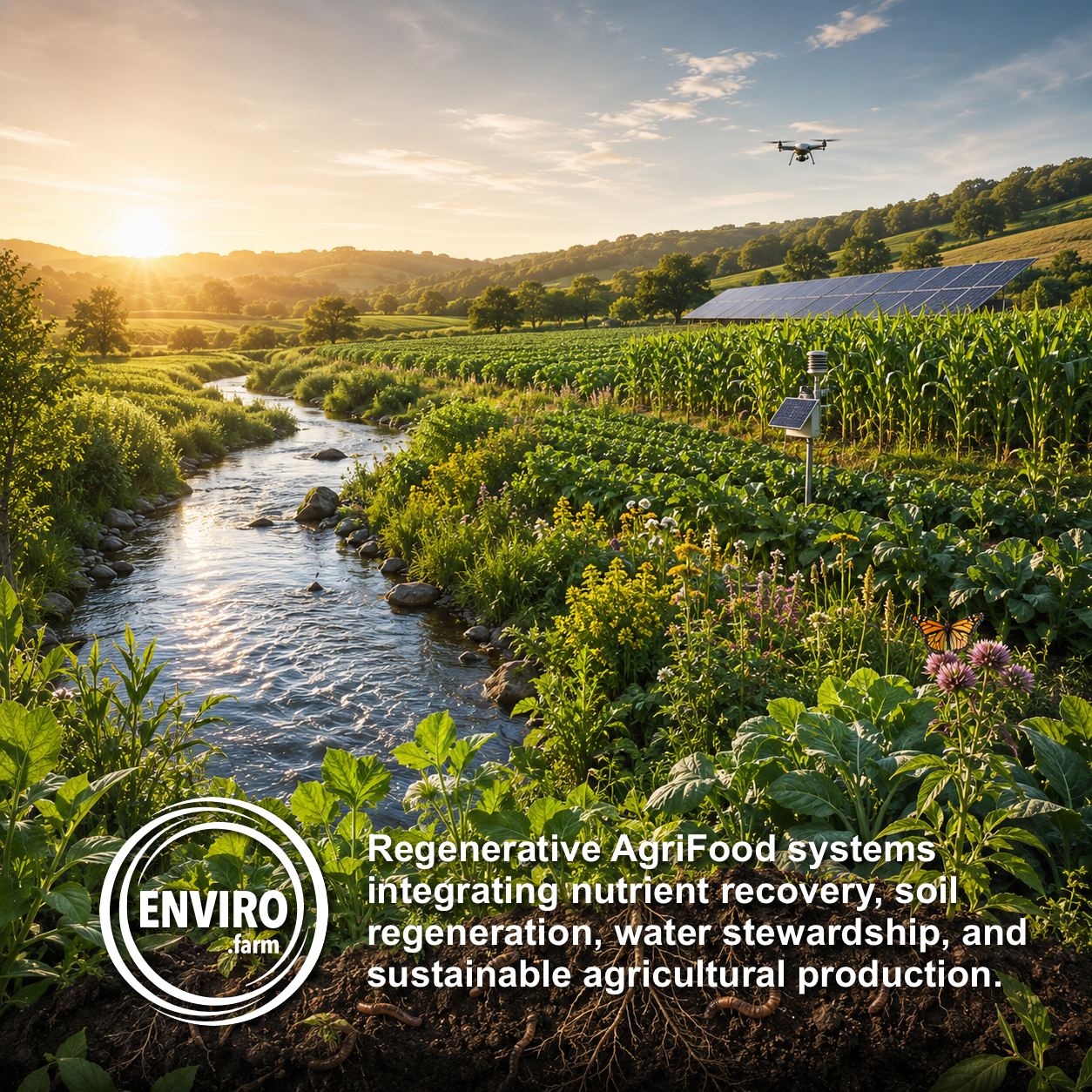
Rethinking ESG Through Regeneration
Many sustainability initiatives focus on reducing harm. Regenerative systems take a different approach. Rather than simply minimizing negative impacts, regenerative models are designed to restore, improve, and strengthen natural systems over time.
Within agriculture, this means creating production systems that regenerate soil health, improve nutrient utilization, recycle water resources, reduce emissions, and increase long-term resilience.
For investors, this distinction is important. Regeneration creates opportunities to generate measurable environmental outcomes while supporting productive economic activity.
The Environmental Payoff
The environmental component of ESG often receives the greatest attention. Agricultural systems influence land use, water resources, nutrient cycles, and greenhouse gas emissions.
Regenerative AgriFood models seek to address these challenges through integrated system design.
Potential environmental benefits include:
- Improved soil health and biological activity
- Reduced dependence on synthetic fertilizer inputs
- Nutrient recovery and recycling
- Water treatment and reuse
- Reduced methane emissions
- Reduced ammonia emissions
- Enhanced climate resilience against drought and flood conditions
These outcomes contribute to a production model that focuses on resource efficiency while supporting long-term agricultural productivity.
The Social Payoff
The social dimension of ESG extends beyond employment and community engagement. Increasingly, investors are evaluating how food systems influence public health, food security, and long-term societal outcomes.
One of the most significant emerging conversations involves nutrient density. While food production volumes have increased globally, questions are increasingly being raised regarding nutritional quality and overall human health outcomes.
Regenerative production systems are designed to support healthier soils, improved nutrient cycling, and stronger biological activity. These factors contribute to the broader objective of producing more nutrient-dense food while maintaining agricultural productivity.
At the same time, reducing ammonia emissions and improving environmental stewardship can contribute to improved community and public health outcomes.
The Governance Payoff
Governance remains one of the most overlooked components of ESG. However, for investors, governance often determines whether environmental and social objectives can be consistently achieved and measured.
Effective governance requires transparency, accountability, performance measurement, and repeatable operational processes.
Climate and enviro-tech systems supported by data collection, monitoring, and AI-driven precision management create opportunities for improved oversight and decision-making. These tools help support measurable outcomes while providing investors with greater visibility into operational performance.
Strong governance frameworks strengthen confidence that environmental and social objectives are being achieved in a disciplined and accountable manner.
Why Investors Are Paying Attention
Historically, investors often viewed ESG performance and profitability as competing objectives. Today, that perception is changing.
Increasingly, investors are recognizing that efficient resource utilization, reduced input dependency, regenerative soil practices, water stewardship, and environmental resilience can also improve operational performance and long-term profitability.
Rather than creating additional costs, regenerative systems may create opportunities to lower costs, improve yields, reduce risk exposure, and strengthen long-term business performance.
This alignment between environmental outcomes and financial outcomes is becoming one of the most important developments in sustainable investing.
Investing in Systems That Create Value
The future of ESG investing may depend less on avoiding risk and more on identifying systems capable of creating measurable value across multiple dimensions simultaneously.
Regenerative AgriFood models offer a compelling example of this evolution. By integrating soil regeneration, nutrient recovery, water stewardship, climate resilience, nutrient density, and operational efficiency into a unified production system, these models seek to create environmental, social, and economic value together.
For investors evaluating the future of sustainable agriculture, the question is no longer whether ESG matters.
The question is which systems are best positioned to deliver measurable results.
Call to Action
Enviro.Farm Systems Inc. continues advancing regenerative AgriFood solutions that combine climate and enviro-tech innovation, nutrient recovery, water recycling, soil regeneration, and AI-supported precision agriculture to help create measurable environmental, social, and economic outcomes.